Global Voices, curated by Rozella Kennedy
August, 2026: Across cultures and across time, words and stories have taught us how to survive, thrive, and make meaning of life. Before the printed page, communities and cultures used speech, song, theater, ritual, and other living forms to share knowledge, resist oppression, celebrate joy, and hold memory. I’m on a journey to learn more about and celebrate diverse writers and traditions from around the world, and you’re invited along!
About the Qixi Festival
August marks the Qixi Festival, China’s “Valentine’s Day,” so this is a little dive into some elements around Chinese storytelling over the centuries. I am not expertly learned in Chinese traditions, but I did know that like in many ancient cultures, music, poetry, and prose are blended to create episodic suspense and emotional release. So here are some things I learned and wish to share. If you have more expertise in this topic, I’d love to hear what you’re reading.
About the origins of this festival: once a year, on the seventh day of the seventh lunar month, an earthly cowherd named Niulang and his love, a celestial weaver girl named Zhinü, reunite on a bridge made of magpies. Lovers who started a family but were thwarted by the gods who didn’t want one of theirs cavorting with a mortal, the goddess is separated from her beloved across the Milky Way for the rest of the year. They are granted just this one night together (in many depictions, the presence of the children is minimized, particularly when it’s promoted as a celebration of romance).
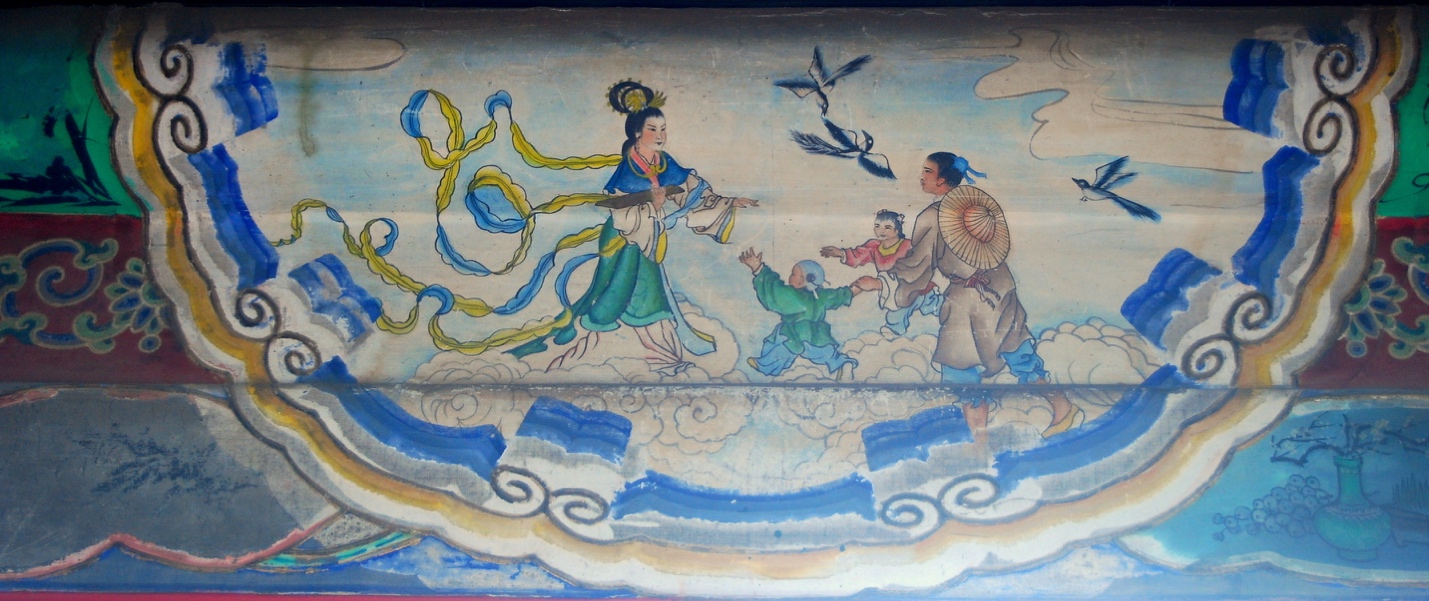
The reunion of the couple of The Weaver Girl and the Cowherd on the bridge of magpies. Artwork in the Long Corridor of the Summer Palace in Beijing. Source: Wikimedia Commons.
Traditionally, women would pray to the spirit of Zhinü the weaver girl, pleading to be blessed with excellent needlework skill and a good love match (I’m imagining the former influenced the latter). Today, the holiday is expressed through more contemporary motives: flowers, special dinners, sweet nothings, not unlike Valentine’s Day in other parts of the world. There is a town in Guangdong called Wangniudun, where they practice a special folk-craft tradition called the Qixi Tribute, in which villagers build elaborate offerings to the weaver girl and her six sister-goddesses out of rice, garlic husk, and melon seed. Their celebration closes with a “Love Concert” of local bands and singers, showing how contemporary pop music derives from the oldest folk observances.
Though it is not a public holiday, Qixi was added to China’s National Intangible Cultural Heritage list in 2006. In homage to this important festival, I focused August’s literary excursion into China and its millennia-long relationship between the spoken and sung word and the written page.
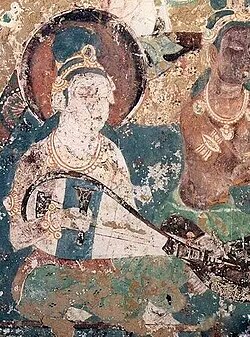
Dunhuang Cave 220, south wall. Pipa. South wall of cave. Early Tang Dynasty (618-907), unknown artist. Source: Wikimedia
A Brief Timeline of Chinese Literary Movements, Melding Song and Story
The period of time we in the West associate with the Middle Ages correlates with the Tang, Song, and Yuan Dynasties in China. Tang (618–907) was dominated by shi, an ancient sung and spoken word recitation performed at social occasions. This poetic form, which is considered to be the root of the Chinese poetic tradition, reached its height in what’s often called the Golden Age of Chinese Poetry. There are three towering figures of this moment: Wang Wei (701–761), who turned nature into a vehicle for meditation through contemplative lyrics and landscape motifs; Li Bai (701–762), considered the freewheeling “Poet-Immortal” for his verses on wine, friendship, and the passage of time; and Du Fu (712–770), often called the single greatest poet in Chinese history, whose work confronted the social and political upheavals of his era with unmatched technical mastery. Bai Juyi (772–846), who admired Du Fu as a poet-historian, extended this tradition with “The Song of Everlasting Sorrow,” a work which literary historians consider an important early example of deep longing inserted into narrative verse.
The Song Dynasty, which lasted from 960 to 1279, saw the emergence of a major lyrical poetic format called ci (aka: “song lyric poetry.”) These poems were written to fit one of roughly 800 existing tunes, (cipai), each of which had its own fixed line lengths, rhyme scheme, and tonal pattern. (Think a songwriter setting new lyrics to an existing melody or chord progression.) This format was perfected by a woman poet named Li Qingzhao, who is considered China’s greatest female poet of all time, even though her work survives only in fragments.
Her male counterpart in reshaping the form was Su Shi (Su Dongpo) (1037–1101), a poet, essayist, calligrapher, painter, and statesman (OK, overachiever!) who pushed ci beyond its romantic, love-song origins into philosophical and historical territory. His work is credited for starting what became known as the “heroic and unconstrained” school of ci poetry.
Teahouse performances were prevalent across these centuries, such as shuōshu (960–1644) and the long-lived píngshū format (c. 1644–1912). After the Song era came the Mongol invasion and the tumult of the Yuan Dynasty (1271–1368). This period, contemporaneous with Europe’s High and Late Middle Ages, (the days of the Black Death) yielded a surge of popular literature, particularly drama, songs, and vernacular storytelling rather than elite court-centered writing. In the West, memorable authors were Dante and Chaucer.
As many readers know, fiction writing was a latter development in the history of storytelling, and during China’s ensuing Ming (1368 to 1644) and Qing (1644–1912) Dynasties, vernacular fiction did take root as a literary form. This was the period of what became known as the Four Great Classical Novels, still considered the pillars of Chinese storytelling today: Luo Guanzhong‘s Romance of the Three Kingdoms, a sprawling account of power struggles following the Han Dynasty‘s collapse; Shi Nai’an‘s Water Margin, following 108 outlaw heroes; Wu Cheng’en‘s Journey to the West, the fantastical pilgrimage tale starring the Monkey King; and Cao Xueqin‘s Dream of the Red Chamber, an intricately observed saga of an aristocratic family’s decline that many widely regard as the single greatest achievement in Chinese fiction.
Even so, fiction remained a secondary form next to poetry and court-centered writing, and it wasn’t until the 20th century and the May Fourth Movement, the aftermath of a student anti-imperialist political movement of the 1910s–20s, that fiction truly became the dominant literary mode.
Fiction Ascendant
The pivotal figure in this transition was Lu Xun (1881–1936), often called the father of modern Chinese literature. His 1918 story “Diary of a Madman” was the first major Chinese fiction written in vernacular language rather than classical literary Chinese, and his sharp, satirical stories, collected in Call to Arms and Wandering, are the model of a modern Chinese fiction tradition of plain speak about ordinary suffering and social hypocrisy. Lu Xun was also an early champion of new voices, notably helping get female trailblazer Xiao Hong‘s (1911–1942) 1934 debut novel, The Field of Life and Death published.
Other prose writers of the twentieth century sought to bring oral sensitivities to the written page as opposed to in performance. Some of the most celebrated names include Mo Yan (b. 1955), who won the 2012 Nobel Prize in Literature for what the Swedish Academy called “hallucinatory realism” that “merges folk tales, history and the contemporary,”and channels village storytellers’ directness into novels like Red Sorghum and Big Breasts and Wide Hips. Mo is the only author from mainland China to win this accolade; Gao Xingjian received it in 2000, but he lives in France. He is known for a “universal” literary vision and linguistic ingenuity, in novels Soul Mountain and One Man’s Bible, as well as plays such as The Bus Stop and Fugitives.
Yu Hua (b. 1960) does something similar to Mo Yan in To Live, which follows one family through civil war, famine, and the Cultural Revolution; banned in China before it became an international sensation, it later inspired Zhang Yimou’s award-winning film. (I have not seen the film, but I adored this gorgeous, gripping book, itself a form of oral history put to page, and devoured it in two days).
Women’s voices are also present in the contemporary Chinese canon. As mentioned, Xiao Hong is now considered a trailblazer, though during her lifetime, she was largely unheralded. Her personal story is relevant to the massive social changes of the era: fleeing an arranged marriage as a teenager, her writing provided stark truth about rural poverty and women’s suffering in Japanese-occupied Manchuria. Her best-known work is the semi-autobiographical Tales of Hulan River, written in Hong Kong shortly before her early death at age 30.
Eileen Chang (1920–1995) created dialogue-driven realism, situating love and loss into 1940s Shanghai in her book Love in a Fallen City. The New York Times has called her “a giant of modern Chinese literature,” and critic C.T. Hsia considered her “the most gifted Chinese writer to emerge in the forties, and certainly the most important,” and named her work The Golden Cangue (collected in the same volume as Love in a Fallen City) “the greatest novelette in the history of Chinese literature.” Like Xiao Hong, appreciation for Chang’s oeuvre accelerated after her sad and lonely death in a reclusive Los Angeles apartment in 1995.
Can Xue (b. 1953) pushes fiction toward dream-logic and parable in books like Five Spice Street and Frontier that read as if someone’s speaking to you directly; critics call her “peerless” among writers of experimental Chinese fiction. Born Deng Xiaohua, she wrote under a gender-neutral pen name so that she would not be hindered as a writer. Once her identity became known, some critics were mightily uncomfortable with a woman writing subversive, avant-garde fiction. And yet, she remains a perennial Nobel Prize contender.
Other Sources
- The Song of Everlasting Sorrow—Society of Classical Poets
- Wang Wei English Translations—chinese-poems.com
- The Golden Cangue—Wikipedia
- Frontier—Open Letter Books
- Nanyin — UNESCO ICH
- Qixi Tribute—Wikipedia
As a member of the San Miguel Writers’ Conference and Literary Festival’s Bridge Builders Committee, I curate a short monthly series for the Festival’s newsletter highlighting Global Voices. That brief overview is published in English and Spanish in the newsletter; the longer essays publish here, in English. Reality Check: While I have not and cannot read all the books I refer to, I am savoring the discoveries as I read, listen, watch, and explore what I can on this global cultural voyage. That’s the spirit of this venture, so I hope it brings you some discovery, delight, and appreciation for our wonderful world of creative people and traditions. I’m also the founder of Brave Sis Project, and reside in San Miguel de Allende, Mexico.